All good stories have a beginning.
Yet, it’s the great stories that never really begin; instead, they evolve.
This is the story of how a livestock show became so much more than showing animals for 4H and eventually, the FFA. Rooted in places of the old rural landscape of Orange, Durham, Person, and surrounding counties of Central North Carolina, the “Livestock Show”, was once the celebration of all things farming and all things farm-kid & farm-family.
The history of this show is unique. Once-upon-a-time, farmers would parade their animals (swine and cattle) down the streets of Durham in a parade of sorts, before descending on the Durham Fairgrounds. It was here that for two days each spring, that hundreds of kids would compete for best in show and best market animal, literally under the gaze of hundreds of onlookers. My mom’s side of the family were part of the early days of the livestock show and the Phelps’ claim to fame is that a grand-champion ribbon did travel back to Hillsborough, and this became Sunday conversation for many decades since, as sort of a reminder that, “we one once.”
For me, the livestock show as an experience that meant more and more as I grew into the concept of showing beef steers. I recall being with my grandfather and selecting two steers each September from the pasture. We didn’t have “show” steers. Our cattle were pedestrian in purpose: meat and market. These cows fed on grassy pastures and hay and sometimes grain. When we put them in the barn, we fed them corn from the field and minerals and eventually, I learned to “halter break” a cow on my own and I became confident in the concept of cleaning and clipping and preparing a cow for the show.
It was labor, certainly. It was also spending many hours and weekends and doing the dirtiest of jobs and working through patience and failure and doing all these things for what I thought was for one purpose: “to win”. As I aged, showing livestock became an important exercise in growing-up and aging into the passion of farming and more importantly, the passion of appreciating the impact of rural America on our ever-complicated modern world.
To this day, I recall the last steer I showed and how defeated I was when the show was over and I did not win and upon walking out of the ring, I knew it was the end. And this is where things are unique to this show. For a kid, there is no ceiling and milk cartons do not expire and everything is new and forever and unending and there is always another day or chance or thing. Yet, the livestock show had finality in age and grade and project and competition and eventually the life of the cow. For a farm-kid, it became more than just a show. Instead, this became a place of growth and the cultivation of life lessons and learning emotion and learning to reason and learning breaking-point and then learning that eventually, even all the good things come to an end. And so, one Spring evening this writer, who was 18 at the time, hugged the neck of a Simental beef steer named, Oak Tree, and walked away from the livestock show believing that the show was over, yet not really understanding that it would eventually find life, again.
My son, Chase was four-years old when he first showed a lamb at the livestock show. He wasn’t supposed to show. He was too young by one-year. Yet, we had broken his lambs to walk with a halter, just like the cows I used to break. We didn’t know that lambs were supposed to be docile and tame and calm, and you could walk them just by holding them under the jaw. Not us. Instead, we full-throttled these lambs. We wrestled them. We lassoed them. We hog-tied them. We rode them. We chased them. We kept the dog from eating them. We fed them the wrong food. We forgot to water them. We inserted IV needles in them, just to see if we could find blood (Chase and his friend Grey did this, and though I was worried about PETA, I was also happy they could probably save my life by finding a vein). And, when it came time to give them a haircut, we may well have used a chainsaw. In fact, these lambs served as so many things and Chase made the paper with his lamb, appropriately named “Farmer’s Helper”.
By the time Ayden entered the showing-stage, Chase had migrated to pigs and so it was natural that Ayden would show pigs, too. Now, if we didn’t know anything about lambs, our knowledge of pigs was limited to nursery-rhyme concepts that pigs like mud and slop (which I still do not know what slop is). You see, we didn’t know that pigs are brilliant animals, and you cannot kill them or tackle them or ride them or pick them up and that they have an incredible defense system in that they scream like they are being abused (which I cannot deny or deny) when you “mess with them”. To walk a pig, you do not use a halter or a leash. It’s not that you don’t, it’s more of a fact that you cannot, with success. I know this. I know this because I saw a pig drag my kid through the mud and my kid giggled and laughed and it was perfect. Yet, to show a pig you use a stick, and you tap it on the opposite shoulder from which you want it to turn (to turn left, you tap right and to turn right, you tap left). To be sure, one of the happiest days of my boys’ early years was when they learned they could use medieval weaponry (a stick or whip), and it be not only allowed but acceptable, to “raise pigs”.
We went through several sticks.
We went through several pigs, too.
Ayden is the only kid I have ever seen that could play a pig with a stick and never make it turn the correct way but always be in tune with the stick on the pig. Ayden also made the paper, showing his pig and by the time we graduated from pigs to steers, we were famous in a smalltown.
When it was decided to bring cows onto the stage that year, the sense of work and labor and urgency and the big of life all seemed to magnify. Chase was first to show, because of his age. Ayden was still wrangling lambs and drumming against the bellies of pigs.
We had to build things and fix things and build a pasture and dig the holes and wire the fence and establish routine and process and the most important aspect of owning livestock and raising kids; we had to establish the process of care.
You see, it’s not that cows come with instruction manuals.
Same, for kids.
Neither do humans.
We started raising cows in a barn assembled in the 1800’s with wooden pegs and it is where mules rested and horses did what horses do and where there was a place for old tac and mule-pulled implements and this would be the place things began for my kids, and where I returned to raise not just cows, but kids, too.
The hay is kept here, and the feed and we built a pasture adjacent and everyday this would be how and where we started and how and where we ended the day. Everyday. Cow ownership and kid raising is an everyday beginning to end and there is no other way to do than to do with care, beginning to end.
It is here that we broke steers and rode steers, and it is here that we tied them to become familiar with a halter and to be still while we washed them and we learned how to shear them and how not to shear them and we learned that really, we rarely did it right or knew what we were doing.
It was also here, that one day I nearly died. I still have the jeans from that day. They were cut by the people in the ambulance, and I kept them as a traumatic-survival souvenir of sorts. I had lassoed a cow and was feeling confident, that it would be ok with a halter around its head. The cow, in some form of self-preservation or ego maintenance, decided the lasso wasn’t user friendly and became enraged in an interesting manner. There is a pear tree nearby, and I can see this cow now, running circles around the tree with each swipe bringing the cow closer to the tree until it was at peak exhaustion. I decided then, perhaps another day we will try a halter, for today was but an initial attempt.
There would not be a second attempt.
Eventually, the cow as coaxed back to the barn and as it was about to enter its stall, I tried to pull the lasso from its neck and slide the halter into position.
Now, I have seen cows do some cow-like things. Yet, until that point, I had never seen a cow nose to the ground, snort, paw the dirt with hoof, and charge me head-first. In a matter of seconds, I was under the belly of an aggravated steer. I felt hooves and pain and the weight of a half-ton animal on my chest and abdomen, and I could not breathe. Then, it happened again. The steer turned, hoof to chest and leapt over the fence behind me and out into the yard.
Eventually, we ate that steer.
It took a few months to recover and recalibrate and following that incident, our livestock showing experiences became more serious and established.
It became clear early on that we were on a journey of sorts. And, journeys are but wanderings, unless you name them. So, one evening over supper my sons and I digested a few names. Here we were, recalibrating in many ways and young and ambitious and becoming passionate about agriculture and farming and labor and the labor of love and thus, we needed a name that reflected our vibe.
Our drums beat different.
To this day, my kids grew from toddler and beyond without owning a video game machine.
We would be and remain happier on a Friday or Saturday, doing something with a tractor or fixing something or taking on a task or being outside in the bright shadows of farm life.
Like many animals with hooves, that seem to trot without rhythm and gypsy their daily travels and enjoy the peace of the wild and unrestrained, we became Hoof Beat Farm.
They say it goes by fast.
For me, a dad trying to raise two boys while also carving a life with the dullest of tools and knives, it goes by at a pace that is unexpectedly perfect.
On this nomadic journey, we discovered a niche opportunity to sell beef from our cows. Paralleling our farms resurgence and some other opportunities, we aligned the relationship between agriculture, seed, earth, beef, and post-brewing consumption. I will not divulge further as some opportunities remain viable. However, we found a way to do something with our journey that became uniquely ours.
Having entered a relationship with Top of the Hill in Chapel Hill, we were able to bring back to our farm the recipe for what I believe makes our beef taste better than anything else. After all, shouldn’t the food we nourish with, also be taste worthy?
We started selling beef in different venues and even today, we maintain a stock of products and customers still come to the farm to buy.
Over the course of a few years, my sons and I would labor through the growth of our farm, our cows, our structure, and life with an unbreakable, undeniable, and undefeated theme: we did this together.
We sold beef to Only Burger in Durham, Top of the Hill in Chapel Hill, House of Gatewood in Hillsborough, The Village Diner in Hillsborough and to hundreds of strangers and friends, alike. We set up farm stands and made posters and started a Facebook Page and we appeared in places that I never thought, and we found gratitude, and we were gracious and somehow, we were humbly surprised, too.
Our operation and our interest in farming and doing this life together was becoming not just something we did, it was something we needed, too.
Eventually, we expanded and began a chapter of building and growing. I think it is interesting to think about how we progressed in terms of structure and tangible feels. Where our early experiences were growing inside a century-plus barn, we needed better places to work cows and a place to grow.
Thus, we pastured an area, and we renovated a barn and added onto a barn and built an entire facility where we could do all the things necessary to farm and grow and most importantly, grow together.
It was at this junction that Chase was an early teenager and suddenly the tunnel was appearing to have light and I did that thing that parents must do and count the years left at home, instead of the candles on the cake. Certainly, you have done this, one day your kid is five and the next your kid leaves for school or life in two years and five and two years took three weeks, or so it seems.
So, we bought heifers and had them bred. And we started raising our own cattle. And we grew and teenage years are unchartered territory for everyone involved, including the new mom’s and their calves. Too this day, I remember one of the most cheerful joys have I ever shared with my sons, was the day we found our first calf. It was November and it had been hot for weeks when it should have been cool and the momma cow was protruding from her belly, big. We kept daily tabs, and we were apprehensively excited and eager and nervous, too. I remember from the cow paddock and shed, seeing the black spot amongst green grass and broom straw, just beyond the pond. I recall running. And, I recall kneeling beside this calf and here we are boys and we are tough and dumb and we break things and fix things and we roll in the mud and clean-up well sometimes and we are father and sons and life is beyond us and we do all the emotions all the time and suddenly a new calf becomes the balance we didn’t know we needed, for balance.
Our journey became very much themed in what we did outside and in farming. To say I was raising farm-kids is very cliché and limiting for me. Certainly, farm life and what we do in the dirt and between the rows and across a field or beside the hay ring or at the wheel of a tractor or covered in grease and blood and filth are different than how other people may life, life. Yet, it was and remains and will be the only-life we know. My kids became and remained integral parts to our farming operations and interests. From our rows and dirt, grain from the farm is resourced for distilling and brewing. From our fields, straw helps with erosion and seeding. And from our calloused and very basic beginnings, we started blending experiences and equipment and interests into landscaping and land infrastructure management practices.
And yet, all of it is related and linked and follows and distinct and beacon guided path to the showing of livestock animals at a livestock show.
In the fall of 2019, we had pregnant heifers and wheat in the ground and beef sales and Chase was 16 and Ayden was 13 and suddenly from lambs at five years old and all the life between, I am a dad with two teenage boys and cows ready to give birth and a magazine writer is with us asking, “How did we get here”. We had been contacted by Our State Magazine about our story. Me, what story? Them, we heard you are raising cows with your sons. Me, “No, I am raising sons, and the cows are helping.”
We are at the table and the boys are just home from school and they start talking. Chase is going to always be the infantry-solider: first to speak and first to charge into confrontation. Ayden is an artillery soldier: He speaks from behind with few words, but they level everything.
We showed the writer, how we live. We recounted paths and how we went from sheep to pigs to cows to grain feeding our cattle a unique blend to what we do and that we also are lucky, and we are doing all these things because it is the only way we know to live and do life. We introduced her, who in turn introduced an audience, to our very simplistically complex world of me trying to find a path of how to live and how to raise sons with agriculture and the outdoors and landscaping and livestock-raising, being the bedrock and the mortar and the foundation from which everything was built. I glanced over the feature when it came-out. I eventually had it framed and I look at it every day. I remember the wind and the cold that day we were interviewed. And I remember how I was at that place in life, beginning to process that the kids were not five and eight and that they were growing up and into themselves and still, much of what they were growing from, remained to be from farming and working and most definitely, livestock raising and showing. I remember wanting that “theme” to become woven into the story somehow and to be able to share that it is still possible to grab life by the horns, or from beneath the belly of a steer in my case, and wrangle kids into a discipline of agriculture life and convince them that they can teach a 1200-lb steer to walk with a rope. Yet, I just let them talk and explain and answer questions and share and be the infantry and artillery that they really are.
To be sure, it was never like we were living on Little House on the Prairie. We still did the things that provided us the proper balance of distraction and commitment. Both kids played lacrosse and at this point, Chase was the varsity goalie while Ayden was terrorizing opponents on defense with his constant pig-whipping style of using the lacrosse stick to attract attention from the referees. During a particularly important tournament run, the livestock show coincided with an important lacrosse game. It became apparent that I had to talk with coach. For a moment, he must have thought I was Michael Landon on Littles on the Prairie, as I explained, “You see, we raise cows, and this is what we do, and Chase needs to be here to walk his cow in the ring.” To which the coach was as bewildered as I was at the words I had spoken. Literally, Chase arrived at the show that night wearing his pads and jersey and changed in my truck and walked his cow into the ring, having played and won the game and rushing to get to a barn so he could show his cow.
And then again, like all journeys and life twists and turns, where Chase had been showing livestock since he was five, it ended abruptly that Spring of 2020.
It was the continuation of never-happened before, when the Livestock Show was cancelled, effectively ending Chase’s showing years. In a sense, it ended high school for his peer group and the complications of our world, dismantled rites of passage and that feeling of “we know this is the last time, so we are going to enjoy it” moments that are part of parent-late teenage years. Like everyone else, we had worked with our cows since August and now all efforts and all works turned into a scramble to keep up with sudden demands for beef and the even more abrupt end of selling beef to restaurants. Things changed. It remains to be known if they changed for better or worse. Yet, what I recognize now and what I did not know to recognize then, was that what was very important to us and to how I raised my kids, was now gone, at least for Chase.
I think for me, I didn’t know which emotion to land upon, nor that I needed to land on an emotion at all. There was so much cloudiness in our world. Suddenly, almost everything we did or wanted to do or could do was “wrong”. Again, almost everything. What remained and what remains, is the life process of farming and agriculture and being outdoors and really, these things are never wrong. In reflection, those clouds in our world and seemingly everything associated during the dark lens of pandemic, are when I became closest with my sons. Somehow, when the world was shutting down, we were opening to each other in the most transitional of ages.
We didn’t participate in the livestock show that following Spring of 2021. It felt very much unorthodox in purpose and how it was constructed. Our cows were spoken for by many customers and instead of preparing for a livestock show and all the things of Spring, we were growing our landscaping business into something we wanted to grow.
Chase would graduate from High School that June. We would do the summer-things. He started East Carolina that August and immediately what had been a world of balance and routine and familiar and safe and sound and together, looked unnerving and without clarity.
That Autumn, change was all encompassing. Everything was different and loss and sadness were themes of routine and what had been. Suddenly all that had been the three of us and what we did, became what me and Ayden would do together and without Chase. It was odd. It was new. It was traveling familiar paths and yet not knowing the next steps. There was growth. There was terror. There was struggle. There were some lonely moments and yet one September afternoon, me and Ayden went to buy cows.
Of all the things that had changed and been different and wrong and all the emotional voyages of that two-year span, buying cows was the most normal thing we did.
We did the things. We found a way to become a new routine. We found a way to grow and together, raise a few steers. It was that Spring of 2022, that we returned to the livestock show, again.
Our cows are never the best. We never name them. We are just as surprised as the cows are surprised, that we make it to the show. It was just me and Ayden and we don’t know what we are doing, and our brains are scattered hyperactive places of thought, and our attention is somewhere between squirrel and chipmunk and gnat and the wind. And yet, Ayden entered the ring with two steers as a Sophomore in High School, and in a sense the routines had found nest, and all the changes were tucked away and life was recalibrating or so it would seem.
We did the things that fall that brought more cows and more growth and a sense of reflection and finality and that things soon would be different. In the Spring of 2023, we brought two steers to the livestock show and Ayden did the walk of labor and purpose, and we followed familiar paths of this is what we do and what always we have done.
It was September 2023, and we were with the Wes and Adam Huskins, and we were looking over a paddock of cows and we selected two and it was then that the first of the lasts would begin. I remember me and Ayden looking over one of the larger steers and we both heard Adam say, “Now, his momma is different.”
When a cow farmer says a cow is different, what they mean to say is that the cow is on the wilder side of the cloth. We both saw the cow try to leap the 7-foot fence. We saw the cow ram it’s head into the panels. We saw the cow kick. And all I could think about was, “this is the last time.”
The cows came to us a few days later and almost immediately, became sick. We had never had problems before and for the first few weeks, the steers would have to be under the care of a vet and our hands-on time would be interrupted by the process of getting the cows better. By late October the cows settled and became healthier, and we could follow feed and grow routines and the get to know each-other routines and gradually we advanced to halter and walking routines.
The days did as the days, do.
The weeks did as the weeks, do.
The months did as the seasons do and the wind does, and the moon shows, and the leaves change, and the branches are bare, and the cold of air becomes warmer air and suddenly it is time.
As it usually goes, in those final few weeks, our cows became more trusting and following in our lead. We continued the process of feed and care. We continued the process of working with something so wild and large and hoping it would do as we want. Every day, we talked to them and led them with halter and did all these things as we have always done them and yet it was so very different and finite, and it created a form of empty sadness.
You see, this was what we as my very small family had always done. We were so very young, and the world was suddenly giving us animals to ride and draw blood from and feed and wash and groom and all the things my boys did in the mud and in the fields and in the stalls was suddenly flooding my mind. And, youth was still very much in my parenting and somehow the old wooden barn the dirt of the ground and the struggle to weave emotion and change and process choice and outcome and somehow it was all connected to raising livestock and following familiar paths and creating new ones and here in the final weeks of a livestock show, one very clear and profound place of emotion and reckoning and understanding and processing was becoming most clear:
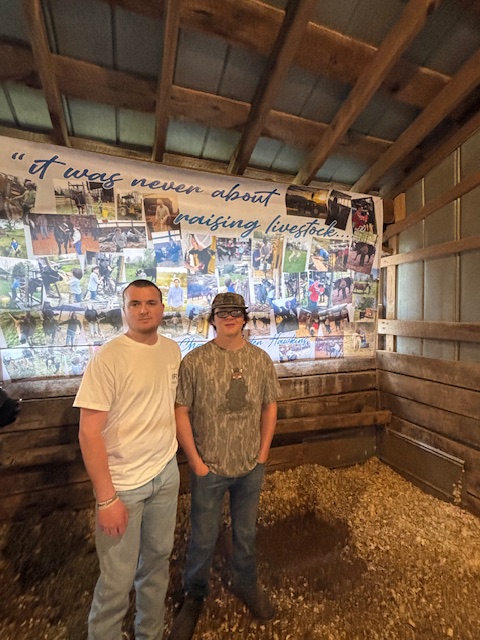
It was never about raising livestock.
True, our beef tastes great and we care for these animals as farmers do and even though we may not look like farmers or talk like farmers or act like farmers, we still do the hay and do the feed and do the fences and do the things that made us family and whole, and we did this together.
And it is true, we cannot possibly sustain life through farming and we don’t survive from what is planted and what may or may not get rain and yet, we find life and purpose and opportunity and we have grown between fields of sun and broken equipment and near death experiences and the trauma of life changes and through it all, we held tight to a halter and we cared and we loved and we did these things whole as they made us family.
And, it is true, we cannot show animals again and break steers and wrangle pigs and clip and wash and brush and lead and use a show stick and we cannot drive up that hill on Orange Grove Road and see the rural landscape and for a moment feel as though we belong and even though we want to win it all, we are really here because this is a celebration of and acknowledgement of who we are as family and father and sons and we have been through so much of what life gives and shares and creates and challenges and we did these things whole, because it made us family.
And, it is very true, that we have memories and jeans my kids wore when they were six and the ones they cut off me in an ambulance and we have the headgate and the hay rack and we have cowboy hats and belts and show sticks that are broken in a box and we have ribbons and some brushes and a pig whipping stick and we have newspaper photographs and a magazine feature and we have a label on beef and we still sell a few pounds and we have all of these relics and reminders and emotional establishments and what I hope we most have and maintain and draw near is that we did these things whole and we did them together and we did these as they made us imperfectly whole as a family.
It was never about raising livestock.
And so even now, a few weeks away from that last time, I contemplate place and purpose and meaning and emotion and what is tangible and what is not. In the week following our last show, I did some work in the stables and stalls to clean them out and to remove manure that will be used for compost and to disrupt the mouse hotels and the places that needed cleaning. It felt so sad. I remember building this place and I look at the worn edges of boards and the places the cows rubbed their heads and the place we tied them and the gate that was hung and swung evenly and true and I look at the cut hay-string on the walls and I see my boys being so young and full of zeal and hope and I see cows that liked the food and liked the bath and at the end they served a purpose to feed and grow and sustain and while in this place, I moved the pile of compost to the outside. And it is here that it has existed. For three weeks and in the memories of what was and in the disturbance of what is to come and even though I can move the pile and finish cleaning and organize and move forward, I am inhibited by these final acknowledgements that it is over.
It was never about raising livestock.
And we do not always know when it is over. Perhaps that is the way it should be and things being over in a sudden and less planned manner are perhaps easier to emotionally titrate. Yet, when it meant so much more than raising livestock, we grew by being dragged through the mud and thrown against barbed wire and learning to process defeat and failure. When it meant so much more than raising livestock, the tears of anger and impatience and joy and Friday nights sitting on a weathered board eating a hamburger and watching the sun set and processing the work from that day were the happiest of places. When it meant so much more than raising livestock, one can look at the fence posts and the stalls and the water trough and the places the cows liked to rest and watch us and one can reflect on pouring the pad for the headgate and nailing the first and the last board and loading in hay and stacking feed and when it is over, one can almost move the compost pile. When it is much more than raising livestock, for reasons that are stronger than emotion and physical place and intent, sometimes you cannot let it go and do the things to signal it is over and sometimes you cannot move the pile of compost.
It was never about raising livestock.
On a Thursday morning, we loaded the last of the two steers for slaughter. Everyone sees the farmer in the field on the tractor doing the things in the rows and in the dirt, and yet they do not see the farmer from the inside where callouses hide and denim disguises the sadness from loading the steers for what would become their end. It is a deliberate torture, and you know what it is. You know that the cows know. You know that this is the hardest part as it is tangible and real and that the cycle of things must include this place and process. And you know that it’s what it is. That cows serve a purpose. Showing cows, serves a purpose. Feeding cows, serves a purpose. Washing cows and caring for cows and loading cows and driving up that hill and then driving to slaughter, serves a purpose.
It was never about raising livestock.
Between these many rows of emotional fields and furrows, there becomes acknowledgement that we did this for more than showing animals for ribbons and trophy. We did this because parenting for me was about trying to do it the best way I thought was the best way. We did this because my boys loved the connection of labor and love and labor and laughter and somehow, we grew from small boys only as big as a lamb, to young men who know the pain and emotion and actuality of physical labor and the labor of processing life. We did this when we could not afford to do this. We did this when we could not set a post correctly in rocky soil. We did this when we could remember to turn the water off and we drained the well. We did this when the judge in the ring looked at our cows and judged them poorly because on the outside, they looked unfinished and not good enough and not the winner and not the one to beat. And it is here that a kid, hears they need to try harder, and you teach your kid to hear that critique with a smile and to say thank you. It is here that you as a parent hear the things and see your kid not winning and the entire time, you reflect on the struggles and the troubles and being under the belly of a cow and then seeing your kid leave the bed early and go feed cows before school and spend Saturday nights shoveling manure and trying to walk a cow or chase a pig or stack the hay in the heat or process life and puberty and sadness and failure and pandemic and the world is shut down and you look at the judge and you think to yourself, it was never about raising livestock.
And so, the compost remains outside the barn in a pile.
Ayden is a senior in high school and the big bad ugly world is roaring to becomes something he faces, soon.
Chase is a rising senior in college and there are plans and hopes and goals and the big bad ugly world is also screaming to become something he faces, soon.
The cows were taken to slaughter and the meat is in the freezer and people do not know what farmers endure in placing a price on something that is more valuable than money.
These experiences and places of contemplation and reflection are manifold, to showing livestock. There was a time, when I was a Senior in High School, and I was doing so very poorly in school and life was bigger and uglier than me. And I remember a common red colored color steer that I had named Oak Tree. Literally, it was me and him and he was my FFA project, and I did all the things and cared for him as best a teenager could. I remember loading him up in a wooden livestock trailer and my grandfather riding with me to the show, it would be the last time I showed. I can still see the wooden box we used to hold the brush and the comb and the bristle brush for scrubbing. I still have the comb on my bookshelf in my office. I recall the red show-stick my grandmother purchased and gave to me. I still have the show stick and when I see it, I think of my grandmother and my time in showing steers and I know it is more than a red stick with a black handle with a silver point and curve at the end. I see the hay bale in the back of the truck and the bucket, and the feed and the cylindrical cardboard oil can we used to scoop minerals into the corn, to feed the cows. And I see me not winning. I see the judge saying things that criticized the cow. It wasn’t good enough. It wasn’t finished enough. It wasn’t the best of the show. It wasn’t what we would want to see on the rail.
And then, I see the end that night. I see my hugging the neck of a cow and thanking it over and over for being what it was. And then, I see the first time I helped Chase lead a lamb into the ring. I see the first time I helped Ayden lift a bucket to feed his pigs. I see Chase running up the hill in a lacrosse uniform and he is desperate to change and get to his cow. And I see Ayden, sitting on his cow in the barn and he is a thousand-word picture and stoic and quiet and strong and he is a kid navigating his way and suddenly he is seventeen. And, on an early April day in the afternoon, he his clipping his cow and loading the trailer and doing the things he does and somewhere in the box of things he packs, he places the red show stick with the black handle with the silver curve and point at the end and he looks at me and, he knows.
The week before our last show, I called a friend and said, “I need you to make a banner.” That night, I sent three dozen pictures and the words, “It was never about raising livestock” to my friend for design and print. On this banner are random pictures of my kids, doing what they did. There is a picture of my father, standing beside me and though he wasn’t always a presence in raising livestock and being there every day, he was there when it needed to last forever. And there is a picture I found, again. It is my grandfather and he is walking a horse in a parade and he is dressed in denim and he is a farmer’s farmer and known to many and the horse is not a show horse and the cows on the farm were never show cows and yet the beef fed and feeds us and the land grows and provides for us and the wooden box held a brush and it is on my shelf and really, that judge was wrong.
You see, for all the faults we endure, there is hope that they are investments in something larger than us: faith, love, work, and hope. The livestock we showed were but vessels of these things. It is faith that protects us and provides and balances us. It is love that a parent or grandparent shows that endures. It is work that keeps us true and maintains our bodies and mind. And it is hope that we cling to, like a boy and his lamb and a kid and his steer and a teenager lost in the 1990’s with a steer named Oak Tree amongst a big bad ugly world.
It was never about raising livestock.
It will never be about not raising livestock.
Perhaps our cows and pigs and lambs, never won the show or won the ribbon or exhibited what a judge thought was best.
Yet, I know. My kids, they know. My family, they know. Our friends that farm and toil in the soil, they know. Those that grew amongst the rows and on the fences and in the stalls and while stacking the hay, they know.
It was never about raising livestock.
To my sons, thank you for an amazing journey. To my family, thank you for all that you did and do to help boys become men and boys become workers and farmers. To all those that maintain and provide opportunity to show livestock, thank you.


Leave a Reply